
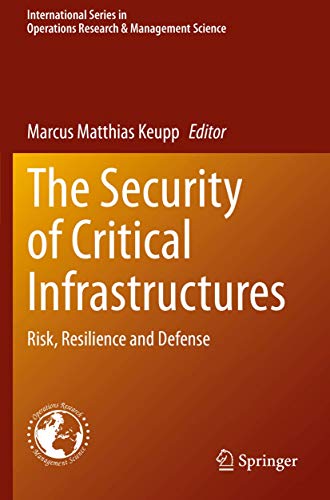
The Security of Critical Infrastructures : risk, resilience and defense / edited by Marcus Matthias Keupp
Language: English. Publication details: Switzerland : Springer, 2020.Description: xiv, 206pISBN:- 9783030418281
- 005.8 SEC-
| Cover image | Item type | Current library | Home library | Collection | Shelving location | Call number | Materials specified | Vol info | URL | Copy number | Status | Notes | Date due | Barcode | Item holds | Item hold queue priority | Course reserves | |
|---|---|---|---|---|---|---|---|---|---|---|---|---|---|---|---|---|---|---|
 Books
Books
|
NASSDOC Library | 005.8 SEC- (Browse shelf(Opens below)) | Available | 53269 |
This book analyzes the security of critical infrastructures such as road, rail, water, health, and electricity networks that are vital for a nation’s society and economy, and assesses the resilience of these networks to intentional attacks. The book combines the analytical capabilities of experts in operations research and management, economics, risk analysis, and defense management, and presents graph theoretical analysis, advanced statistics, and applied modeling methods. In many chapters, the authors provide reproducible code that is available from the publisher’s website. Lastly, the book identifies and discusses implications for risk assessment, policy, and insurability. The insights it offers are globally applicable, and not limited to particular locations, countries or contexts.
Researchers, intelligence analysts, homeland security staff, and professionals who operate critical infrastructures will greatly benefit from the methods, models and findings presented. While each of the twelve chapters is self-contained, taken together they provide a sound basis for informed decision-making and more effective operations, policy, and defense.
English.
There are no comments on this title.