
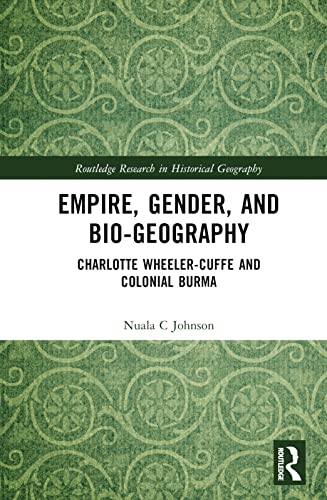
Empire, gender and bio-geography : Charlotte wheeler-cuffe and colonial burma/ Naula C Johnson
Publication details: New York: Routledge, 2024.Description: viii, 231pISBN:- 9780367743932
- 9780367743949
- 581.00222 JOH-E
| Cover image | Item type | Current library | Home library | Collection | Shelving location | Call number | Materials specified | Vol info | URL | Copy number | Status | Notes | Date due | Barcode | Item holds | Item hold queue priority | Course reserves | |
|---|---|---|---|---|---|---|---|---|---|---|---|---|---|---|---|---|---|---|
 Books
Books
|
NASSDOC Library | 581.00222 JOH-E (Browse shelf(Opens below)) | Available | 54211 |
Includes bibliographical references and index.
Setting the scene -- Family matters : Charlotte Wheeler-Cuffe 1867-1987 -- Encountering the tropics 1898-1899 -- Mobility and cultures of expedition 1900-1903 -- Networks of knowledge and exploring Upper Burma 1904-1910 -- Deepening connections: Rangoon, Mount Victoria and the Andaman Islands 1911-1912 -- Hill Stations, plant hunting and the Irrawaddy-Salween Divide 1913-14 -- Maymyo botanic garden and the final Burmese days 1915-1921.
"This book explores the relationships between empire, natural history and gender in the production of geographical knowledge and its translation between colonial Burma and Britain. Focusing on the work of the plant collector, botanical illustrator and naturalist, Charlotte Wheeler-Cuffe, this book illustrates how natural history was practiced and produced by a woman working in the tropics from 1897-1921. Drawing on the extensive and under-studied archive of private and official correspondence, diaries, sketchbooks, photographs, paintings, and plant lists of Wheeler-Cuffe, this book advances our conceptual understanding of the 'invisible' historical geographies underpinning scientific knowledge production, by focusing on the role of a female actor in the complex gendered setting of colonial Burma. Using a bio-geographical approach, this analysis reconceptualizes female agency beyond authorship and publication, and stresses how Wheeler-Cuffe represents an instantiation of the occluded contribution of women to the historiography of natural history. This book highlights Wheeler-Cuffe's production of scientific knowledge about Burma in the context of her relationship, as a white Western woman, with local, indigenous actors and details her practice of fieldwork and its embodied geographies in different parts of Burma, while she maintained the domestic superstructure of a colonial wife. This book will be of interest to advance level students and researchers in historical and cultural geography; the history of science; feminist geography; women and natural history; colonial Burma and imperialism; and botanical art and illustration"--
English.
There are no comments on this title.