
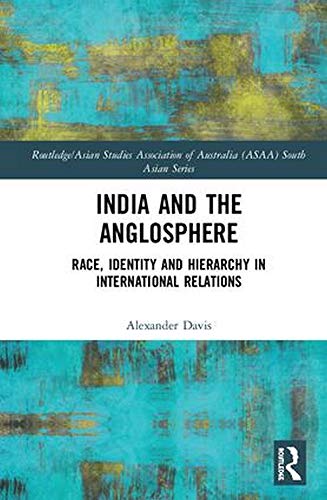
India and the anglosphere
Series: Race, identity and hierarchy in international relationsPublication details: Routledge 2019 New YorkDescription: viii, 200pISBN:- 9780367363499
- 327.54 DAV-I
| Cover image | Item type | Current library | Home library | Collection | Shelving location | Call number | Materials specified | Vol info | URL | Copy number | Status | Notes | Date due | Barcode | Item holds | Item hold queue priority | Course reserves | |
|---|---|---|---|---|---|---|---|---|---|---|---|---|---|---|---|---|---|---|
 Books
Books
|
NASSDOC Library | 327.54 DAV-I (Browse shelf(Opens below)) | Available | 50704 |
Include Bibliography and Index
India has become known in the US, the UK, Canada and Australia as 'the world's largest democracy', a 'natural ally', the 'democratic counterweight' to China and a trading partner of 'massive economic potential'. This new foreign policy orthodoxy assumes that India will join with these four states and act just as any other democracy would. A set of political and think tank elites has emerged which seek to advance the cause of a culturally superior, if ill-defined, 'Anglosphere'. Building on postcolonial and constructivist approaches to international relations, this book argues that the same Eurocentric assumptions about India pervade the foreign policies of the Anglosphere states, international relations theory and the idea of the Anglosphere. The assertion of a shared cultural superiority has long guided the foreign policies of the US, the UK, Canada and Australia, and this has been central to these states' relationships with postcolonial India. This book details these difficulties through historical and contemporary case studies, which reveal the impossibility of drawing India into Anglosphere-type relationships. At the centre of India-Anglosphere relations, then, is not a shared resonance over liberal ideals, but a postcolonial clash over race, identity and hierarchy. A valuable contribution to the much-needed scholarly quest to follow a critical lens of inquiry into international relations, this book will be of interest to academics and advanced students in international relations, Indian foreign policy, Asian studies, and those interested in the 'Anglosphere' as a concept in international affairs.
There are no comments on this title.