
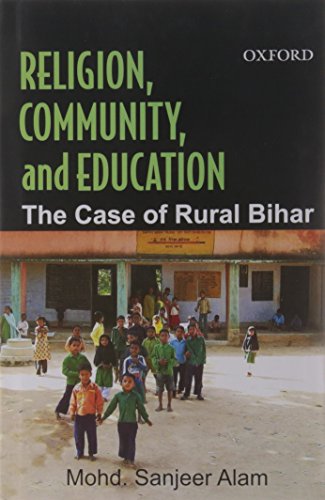
Religion, Community and Education : The Case of Rural Bihar
Publication details: New Delhi Oxford University Press 2012Description: xv,219pISBN:- 9780198076940
- 379.260954123 ALA-R
| Cover image | Item type | Current library | Home library | Collection | Shelving location | Call number | Materials specified | Vol info | URL | Copy number | Status | Notes | Date due | Barcode | Item holds | Item hold queue priority | Course reserves | |
|---|---|---|---|---|---|---|---|---|---|---|---|---|---|---|---|---|---|---|
 Books
Books
|
NASSDOC Library | 379.260954123 ALA-R (Browse shelf(Opens below)) | Available | 51201 |
Browsing NASSDOC Library shelves Close shelf browser (Hides shelf browser)

|

|

|

|
No cover image available |

|

|
||
| 379.26 PER-E Equity warriors : | 379.260954 MAJ-E Education and inequality in India: a classroom view | 379.260954 MAT-R Right to Education in India | 379.260954123 ALA-R Religion, Community and Education | 379.260954558 DUG-R Right to education in Haryana | 379.41 HAR-B Beyond schooling : | 379.41 WAR-K Key issues in education policy / |
Included Bibliography and Index
Religion-based educational disparities, especially relative educational backwardness amongst the Muslims in India, are the focus of serious debate. The 2006 Sachar Committee Report rekindled public interest and attention in this important issue. Yet, considerable gaps exist in our understanding of the dynamics of religion and access to education. In Religion, Community, and Education, Alam uses a spatial approach and multi-layered analytical framework to understand educational disparities in schooling between the Hindus and Muslims in Bihar. The study draws upon national-level data as well as focused fieldwork carried out in Bihar’s Patna and Purnia districts. This book highlights the larger historical trajectories that have shaped educational development as well as the forms of disparities therein vis-à-vis the minorities in India. It contends that the relative educational backwardness of the Muslims reflects underlying socio-economic patterns that are often overlooked. Thus, the Muslims should not be seen merely as homogeneous socio-cultural aggregates
There are no comments on this title.