
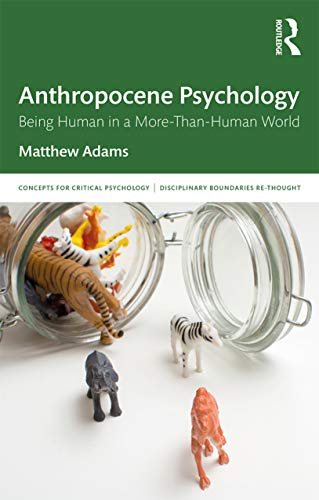
Antropocene Psychology : Being Human in a More-Than-Human World
Series: Concepts for Critical Psychology :disciplinary Boundaries Re-ThoughtPublication details: Routledge Taylor & Francis Group New York 2020Description: xiv,193pISBN:- 9781138570252
- 155.91 ADA-A
| Cover image | Item type | Current library | Home library | Collection | Shelving location | Call number | Materials specified | Vol info | URL | Copy number | Status | Notes | Date due | Barcode | Item holds | Item hold queue priority | Course reserves | |
|---|---|---|---|---|---|---|---|---|---|---|---|---|---|---|---|---|---|---|
 Books
Books
|
NASSDOC Library | 155.91 ADA-A (Browse shelf(Opens below)) | Available | 51350 |
Browsing NASSDOC Library shelves Close shelf browser (Hides shelf browser)

|

|

|

|

|

|

|
||
| 155.9042 HAN- Handbook of multicultural perspectives on stress and coping | 155.9042 MAN- Managing stress: | 155.9042 NAY-A Against all odds : | 155.91 ADA-A Antropocene Psychology | 155.9115 TEW-; Noise, communication and cognitive functions | 155.915 BEA-M Psychology of climate change | 155.916 SRI-; Stress presonality and cancer |
includes index
This ground-breaking book critically extends the psychological project, seeking to investigate the relations between human and more-than-human worlds against the backdrop of the Anthropocene by emphasising the significance of encounter, interaction and relationships. Interdisciplinary environmental theorist Matthew Adams draws inspiration from a wealth of ideas emerging in human-animal studies, anthrozoology, multi-species ethnography and posthumanism, offering a framing of collective anthropogenic ecological crises to provocatively argue that the Anthropocene is also an invitation - to become conscious of the ways in which human and nonhuman are inextricably connected. Through a series of strange encounters between human and nonhuman worlds, Adams argues for the importance of cultivating attentiveness to the specific and situated ways in which the fates of multiple species are bound together in the Anthropocene. Throughout the book this argument is put into practice, incorporating everything from Pavlov's dogs, broiler chickens, urban trees, grazing sheep and beached whales, to argue that the Anthropocene can be good to think with, conducive to a seeing ourselves and our place in the world with a renewed sense of connection, responsibility and love. Building on developments in feminist and social theory, anthropology, ecopsychology, environmental psychology, (post)humanities, psychoanalysis and phenomenology, this is fascinating reading for academics and students in the field of critical psychology, environmental psychology, and human-animal studies.
There are no comments on this title.