
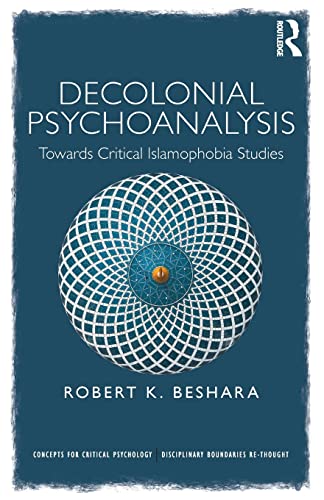
Decolonial Psychoanalysis : Towards Critical Islamophobia Studies
Series: Concepts for Critical Psychology: Disciplinary Boundaries Re-ThoughtPublication details: Routledge Taylor & Francis Group New York 2019Description: xii,161pISBN:- 9780367174132
- 305.697019 BES-D
| Cover image | Item type | Current library | Home library | Collection | Shelving location | Call number | Materials specified | Vol info | URL | Copy number | Status | Notes | Date due | Barcode | Item holds | Item hold queue priority | Course reserves | |
|---|---|---|---|---|---|---|---|---|---|---|---|---|---|---|---|---|---|---|
 Books
Books
|
NASSDOC Library | 305.697019 BES-D (Browse shelf(Opens below)) | Available | 51353 |
Browsing NASSDOC Library shelves Close shelf browser (Hides shelf browser)

|
No cover image available |

|

|

|

|

|
||
| 305.697 IBR-R Rohingyas | 305.697 NAT-F Frontiers of embedded Muslim communities in South Asia: domestic and public sphe | 305.697 RAN-S साम्प्रदायिकता का ज़हर / | 305.697019 BES-D Decolonial Psychoanalysis | 305.697083054 HUS-C Contemporary muslim girlhoods in India : | 305.697094 MON-Y Young british Muslim voices | 305.6970954 ISL-I Indian Muslim(s) after liberalization / |
Includes reference & index
In this provocative and necessary book, Robert K. Beshara uses psychoanalytic discursive analysis to explore the possibility of a genuinely anti-colonial critical psychology. Drawing on postcolonial and decolonial approaches to Islamophobia, this book enhances understandings of Critical Border Thinking and Lacanian Discourse Analysis, alongside other theoretico-methodological approaches. Using a critical decolonial psychology approach to conceptualize everyday Islamophobia, the author examines theoretical resources situated within the discursive turn, such as decoloniality/transmodernity, and carries out an archeology of (counter)terrorism, a genealogy of the conceptual Muslim, and a Zizekian ideology critique. Conceiving of Decolonial Psychoanalysis as one theoretical resource for Critical Islamophobia Studies (CIS), the author also applies Lacanian Discourse Analysis to extracts from interviews conducted with US Muslims to theorize their ethico-political subjectivity and considers a politics of resistance, adversarial aesthetics, and ethics of liberation. Essential to any attempt to come to terms with the legacy of racism in psychology, and the only critical psychological study on Islamophobia in the United States, this is a fascinating read for anyone interested in a critical approach to Islamophobia.
There are no comments on this title.