
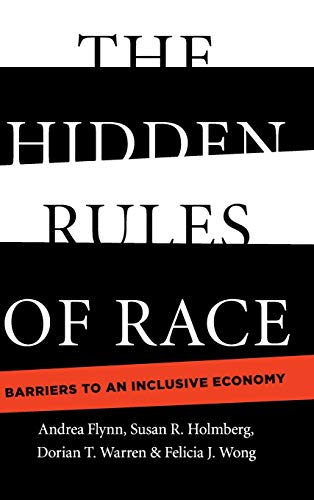
Hidden Rules of Race : Barriers to an inclusive economy
Publication details: Cambridge University Press 2017Description: 232pISBN:- 9781108417549
- 330.97300899 FLY-H
| Cover image | Item type | Current library | Home library | Collection | Shelving location | Call number | Materials specified | Vol info | URL | Copy number | Status | Notes | Date due | Barcode | Item holds | Item hold queue priority | Course reserves | |
|---|---|---|---|---|---|---|---|---|---|---|---|---|---|---|---|---|---|---|
 Books
Books
|
NASSDOC Library | 330.97300899 FLY-H (Browse shelf(Opens below)) | Available | 51582 |
Browsing NASSDOC Library shelves Close shelf browser (Hides shelf browser)

|

|

|

|

|

|

|
||
| 330.971 PER; Proceedings of a seminar | 330.973 CLA-O Open | 330.973 STI-P People, power and profits | 330.97300899 FLY-H Hidden Rules of Race | 330.973091 DOM-C Corporate rich and the Power Elite in the Twentieth Century | 330.9730931 ABO-S Stewards of the Market | 330.9730932 RAS-E Epic recession: prelude to global depression |
Why do black families own less than white families? Why does school segregation persist decades after Brown v. Board of Education? Why is it harder for black adults to vote than for white adults? Will addressing economic inequality solve racial and gender inequality as well? This book answers all of these questions and more by revealing the hidden rules of race that create barriers to inclusion today. While many Americans are familiar with the histories of slavery and Jim Crow, we often don't understand how the rules of those eras undergird today's economy, reproducing the same racial inequities 150 years after the end of slavery and 50 years after the banning of Jim Crow segregation laws. This book shows how the fight for racial equity has been one of progress and retrenchment, a constant push and pull for inclusion over exclusion. By understanding how our economic and racial rules work together, we can write better rules to finally address inequality in America
There are no comments on this title.