
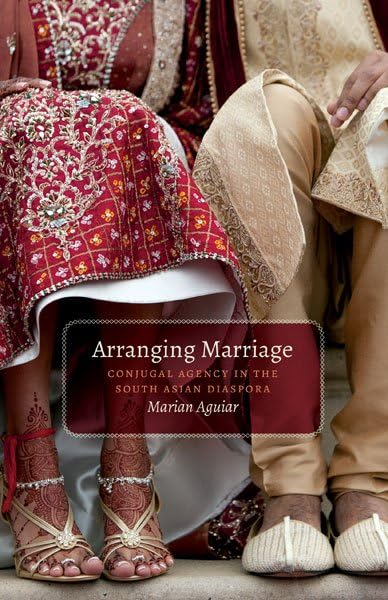
Arranging marriage : conjugal agency in the South Asian diaspora / Marian Aguiar.
Publication details: London University of Minnesota Press 2018Description: xii, 260 pagesISBN:- 9780816689484 (pbk : acidfree paper)
- 392.50954 AGU-A
| Cover image | Item type | Current library | Home library | Collection | Shelving location | Call number | Materials specified | Vol info | URL | Copy number | Status | Notes | Date due | Barcode | Item holds | Item hold queue priority | Course reserves | |
|---|---|---|---|---|---|---|---|---|---|---|---|---|---|---|---|---|---|---|
 Books
Books
|
NASSDOC Library Book Cart | 392.50954 AGU-A (Browse shelf(Opens below)) | Available | 52570 |
Browsing NASSDOC Library shelves,Shelving location: Book Cart Close shelf browser (Hides shelf browser)

|

|

|

|

|

|

|
||
| 370.15 DAV-R Rethinking education through critical psychology : | 371.826914 ARA-H Higher education in the era of migration, displacement and internationalization / | 378.155 UND Understanding contemporary issues in higher education : | 392.50954 AGU-A Arranging marriage : | 599.938 RAO-H Human Evolution, Economic Progress and Evolutionary Failure / | 612.8 SOC Social neuroscience : | 614.42 SPA Spatial Analysis in Health Geography / |
Includes bibliographical references and index.
Introduction: Discursive contexts -- The subject of agency -- "Forced marriage" and a culture of consent -- Britain: the politics of belonging -- The United States and Canada: individual freedom and community -- Regenerating tradition through transnational popular culture -- Conclusion: a cultural studies approach.
Marian Aguiar's book on arranged marriage as a transnational cultural phenomenon provides a sustained analysis of the institution's representation in various forms of media, literature, and policy across the South Asian diaspora of Britain, the United States, and Canada. Aguiar argues that arranged marriage is a global fascination and a subject of curiosity, revulsion, outrage, and envy. She interprets depictions of arranged marriage to illustrate that we are currently in a moment of conjugal globalization, which reveals deep divisions in the processes of globalization constructed on a fault line between individualist and collectivist agency. Aguiar critiques neoliberal celebrations of "culture as choice" that attempt to bridge this separation and advocates for situating arranged marriage discourses within their social and material contexts to see past reductive notions of culture and understand the global forces mediating increasingly polarized visions of agency. Overall, Aguiar's book provides a comprehensive analysis of arranged marriage as a transnational cultural phenomenon and its impact on questions of consent, agency, state power, and national belonging.
English.
There are no comments on this title.