
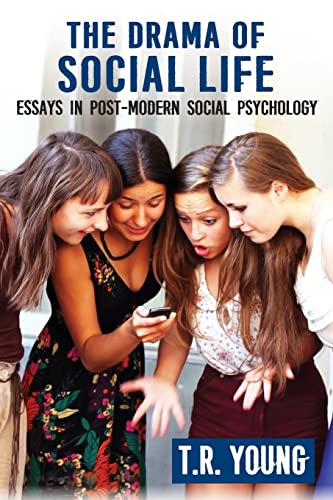
The drama of social life : essays in post-modern social psychology / T.R. Young.
Publication details: New York : Routledge, 2017Description: xiii, 378 pISBN:- 9781412862981
- 302 YOU-T
| Cover image | Item type | Current library | Home library | Collection | Shelving location | Call number | Materials specified | Vol info | URL | Copy number | Status | Notes | Date due | Barcode | Item holds | Item hold queue priority | Course reserves | |
|---|---|---|---|---|---|---|---|---|---|---|---|---|---|---|---|---|---|---|
 Books
Books
|
NASSDOC Library Book Cart | 302 YOU-T (Browse shelf(Opens below)) | Available | 52564 |
Browsing NASSDOC Library shelves,Shelving location: Book Cart Close shelf browser (Hides shelf browser)

|

|

|

|

|

|

|
||
| 181.45 WER-P Pure Yoga : | 300.72 MIC-R The research event : | 302 TAY-P The psychology of human social development : | 302 YOU-T The drama of social life : | 302.072 ROS-E Experimental and nonexperimental designs in social psychology / | 302.1 APP Applications of Social Psychology : | 302.3 THI-S The social psychology of groups / |
"First paperback printing 2016".
Includes bibliographical references and index
The Drama of Social Life, a collection of essays by political sociologist and social theorist, Robert J.C. Young, explores the ways in which theatre and dramaturgy shape the everyday experience of individuals in mass societies. Young argues that in advanced monopoly capitalism, dramaturgy has replaced coercion as the preferred tool of control for managing consumers, workers, voters and state functionaries. He calls this process the "colonization of desire," where desire is transformed into a commodity to be owned and displayed, rather than experienced in interpersonal relationships.
Young asserts that technologies combine with the worlds of art, music and cinema to shape consciousness, which has fragmented social relations in the market as well as in religion and politics. He sees the central problem of post-modern society as the challenge of living in a world constructed by human beings, without nihilism or repressive dogmatism. Young argues that these developments can be observed not only in capitalist societies but also in bureaucratically organized socialist societies.
The book's topics cover a wide range of issues, including the impact of mass media on cultural norms and values, the role of art in shaping political ideologies, and the impact of leisure time on social life. The book is intended for social psychologists, cultural studies scholars, students of moral development, and individuals interested in exploring the uses of "make-believe" in shaping social reality. Overall, The Drama of Social Life provides a critical perspective on the ways in which dramaturgy has been employed to shape our understanding of ourselves and our relationship to society, and offers a thought-provoking analysis of the challenges facing post-modern societies.
English
There are no comments on this title.