
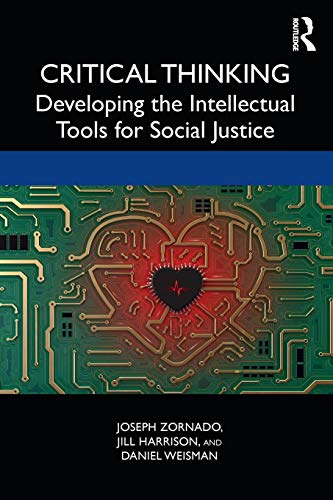
Critical thinking : developing the intellectual tools for social justice / Joseph Zornado, Jill Harrison and Daniel Weisman.
Language: eng- Publication details: Newyork : Routledge, 2019.Edition: First EditionDescription: 178pISBN:- 9780429439544
- 303.372 ZOR-C
| Cover image | Item type | Current library | Home library | Collection | Shelving location | Call number | Materials specified | Vol info | URL | Copy number | Status | Notes | Date due | Barcode | Item holds | Item hold queue priority | Course reserves | |
|---|---|---|---|---|---|---|---|---|---|---|---|---|---|---|---|---|---|---|
 Books
Books
|
NASSDOC Library | 303.372 ZOR-C (Browse shelf(Opens below)) | Available | 53343 |
Browsing NASSDOC Library shelves Close shelf browser (Hides shelf browser)

|
No cover image available |

|

|
No cover image available |

|

|
||
| 303.372 SAR-R Refugee Law in India : | 303.372 THO-S Social justice philanthropy | 303.372 TIM-Q Qualitative inquiry for social justice/ | 303.372 ZOR-C Critical thinking : | 303.3720954 DES-; Social justice: a dialogue | 303.3720954 KRI-S Social Exclusion and Justice in India | 303.3720954 MUL- मूल्यों की पुनःस्थापना |
Includes bibliographical references and index.
"Critical Thinking presents, defines and explains the intellectual skills and habits of mind that comprise critical thinking and its relationship to social justice. Each of the sequential chapters includes detailed examples and learning exercises that guide the reader step by step from intellectual competency, to critical thinking, to cultural cognition, and to critical awareness necessary for social justice. The book documents and explains the scope of multiple crises facing society today, including environmental destruction, income and wealth inequality, large-scale human migration, and the rise of autocratic governments. It shows how critical thinking, cultural cognition, and critical awareness lead to the possibility of solutions grounded in social justice. All college students, especially those in the social sciences and humanities, will develop the intellectual skills necessary for critically engaging information in order to become active learners and effective agents in the world. This book complements information in introductory, interdisciplinary, or discipline-specific courses. Every chapter contains examples and exercises that can be assigned as homework, adopted as in-class activities, or both. The Conclusion also contains exercises for developing writing and basic mathematical competency skills"--
English.
There are no comments on this title.