
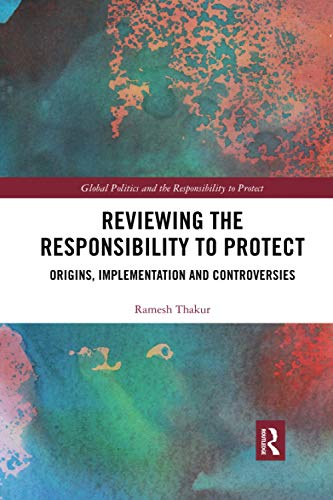
Reviewing the Responsibility to Protect : Origins, Implementation and Controversies / Ramesh Thakur
Language: eng- Publication details: Newyork : Routledge, 2020.Description: 256pISBN:- 9780367498870
- 341.48 THA-R
| Cover image | Item type | Current library | Home library | Collection | Shelving location | Call number | Materials specified | Vol info | URL | Copy number | Status | Notes | Date due | Barcode | Item holds | Item hold queue priority | Course reserves | |
|---|---|---|---|---|---|---|---|---|---|---|---|---|---|---|---|---|---|---|
 Books
Books
|
NASSDOC Library | 341.48 THA-R (Browse shelf(Opens below)) | Available | 53548 |
Browsing NASSDOC Library shelves Close shelf browser (Hides shelf browser)

|

|

|

|

|

|

|
||
| 341.48 ROB-C Contentious History of the International Bill of Human Right | 341.48 ROU- The Routledge handbook on extraterritorial human rights obligations / | 341.48 SMI-T Texts and materials on international human rights / | 341.48 THA-R Reviewing the Responsibility to Protect : | 341.4802 CON-D Defining civil and political rights: the jurisprudence of the United Nations Human Rights Committee | 341.481 HUM- Human rights | 341.481 HUM; Issued Human rights: concept and standards |
Includes bibliographical references and index.
This volume is a collection of some of the key essays by Ramesh Thakur on the origins, implementation and future prospects of the Responsibility to Protect (R2P) norm. The book offers a comprehensive yet accessible review of the origins, evolution, advances and shortcomings of the R2P principle. A literature review is followed by an overview of the background, meaning and development of R2P. With a focus on the International Commission on Intervention and State Sovereignty (ICISS), Part I analyses the features of, and explains the factors that make for success and failure of commission diplomacy. Part II discusses the controversies surrounding efforts to implement R2P, including the role and importance of emerging powers. Part III describes the remaining protection gaps and explains why R2P will remain relevant because it is essentially demand driven. Finally, the book concludes with a look back at the origins of R2P and looks ahead to possible future directions. This book will be essential for students of the Responsibility to Protect, and of much interest to students of global governance, human rights, international law and international relations.
English.
There are no comments on this title.