
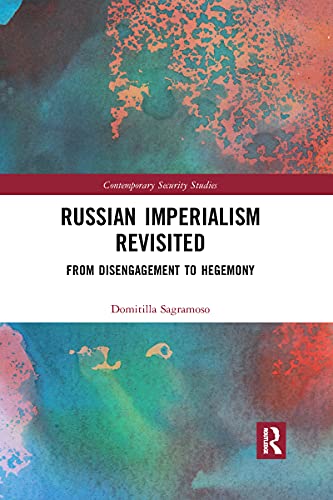
Russian Imperialism Revisited : From Disengagement to Hegemony / Domitilla Sagramoso
Language: eng- Publication details: Newyork : Routledge, 2021.Description: 388p. 3 B/W IllustrationsISBN:- 9781032172989
- 327.47 SAG-R
| Cover image | Item type | Current library | Home library | Collection | Shelving location | Call number | Materials specified | Vol info | URL | Copy number | Status | Notes | Date due | Barcode | Item holds | Item hold queue priority | Course reserves | |
|---|---|---|---|---|---|---|---|---|---|---|---|---|---|---|---|---|---|---|
 Books
Books
|
NASSDOC Library | 327.47 SAG-R (Browse shelf(Opens below)) | Available | 53554 |
Browsing NASSDOC Library shelves Close shelf browser (Hides shelf browser)

|

|

|

|
No cover image available |

|

|
||
| 327.47 AMB-C Challenging America's global preeminence: Russia's quest for multipolarity | 327.47 ISA-R Russian governance in the twenty-first century: geo-strategy, geopolitics and governance | 327.47 KUN-R Russia and its near abroad: | 327.47 SAG-R Russian Imperialism Revisited : | 327.47 ZAG-; For peaceful international relations | 327.47051 BAK-R Russia-China relations: relevance for India | 327.47051 PAN-R Russia-china relation and a changing world order / |
Includes bibliographical references and index.
This book examines the nature of Russia’s relations with the former Soviet states (FSS), in particular with countries which formed the Commonwealth of Independent States, in order to assess whether there has been a resurgence of Russian imperialism since the collapse of the USSR.
The book sets out to determine whether Russian leaders have attempted to restore a sphere of influence over the former Soviet republics or whether Russia’s policies reflect a genuine desire to establish normal state-to-state relations with the new states. It adopts a comprehensive approach, analysing Russia’s policies towards the FSS across a broad range of areas: energy, trade and investment; military assistance, security provision and peacekeeping; conflict management, political support, and alliance formation. While not denying the Kremlin’s assertive role in the FSS, this book challenges the assumption that Russia has always intended to restore a sphere of influence over its ‘Near Abroad’. Rather, it argues that Russia’s policies are much more complex, multi-faceted, and often more incoherent than is often assumed. In essence, Russia's actions generally reflect a combination of legitimate state interests, enduring Soviet legacies, and genuine concerns over events unfolding along Russia’s borders. This book also shows that, at times, Great-Power nostalgia and a real difficulty with discarding Russia’s imperial legacy shapes Russia’s behaviour towards the FSS.
This book will be of great interest to students of Russian politics and foreign policy, east European politics, and International Relations in general.
English.
There are no comments on this title.