
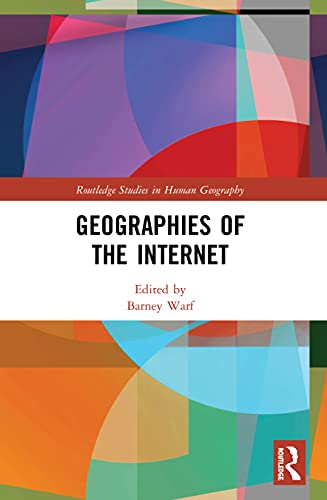
Geographies of the Internet / Edited By Barney Warf
Language: eng- Publication details: Newyork : Routledge, 2022.Description: 382p. 55 B/W IllustrationsISBN:- 9780367502553
- 302.231 GEO-
| Cover image | Item type | Current library | Home library | Collection | Shelving location | Call number | Materials specified | Vol info | URL | Copy number | Status | Notes | Date due | Barcode | Item holds | Item hold queue priority | Course reserves | |
|---|---|---|---|---|---|---|---|---|---|---|---|---|---|---|---|---|---|---|
 Books
Books
|
NASSDOC Library | 302.231 GEO- (Browse shelf(Opens below)) | Available | 53472 |
Browsing NASSDOC Library shelves Close shelf browser (Hides shelf browser)

|

|

|

|

|

|

|
||
| 302.231 BYR-D Digital media, friendship and cultures of care / | 302.231 CYB- Cyberpsychology and Society | 302.231 EER-C Challenging Extremist Views on Social Media | 302.231 GEO- Geographies of the Internet / | 302.231 JOH-W We are data | 302.231 LUP-; Digital sociology | 302.231 MAH-P The Psychology of Social Media / |
Includes bibliographical references and index.
This book offers a comprehensive overview of recent research on the internet, emphasizing its spatial dimensions, geospatial applications, and the numerous social and geographic implications such as the digital divide and the mobile internet.
Written by leading scholars in the field, the book sheds light on the origins and the multiple facets of the internet. It addresses the various definitions of cyberspace and the rise of the World Wide Web, draws upon media theory, as well as explores the physical infrastructure such as the global skein of fibre optics networks and broadband connectivity. Several economic dimensions, such as e-commerce, e-tailing, e-finance, e-government, and e-tourism, are also explored. Apart from its most common uses such as Google Earth, social media like Twitter, and neogeography, this volume also presents the internet’s novel uses for ethnographic research and the study of digital diasporas.
Illustrated with numerous graphics, maps, and charts, the book will best serve as supplementary reading for academics, students, researchers, and as a professional handbook for policy makers involved in communications, media, retailing, and economic development.
English.
There are no comments on this title.