
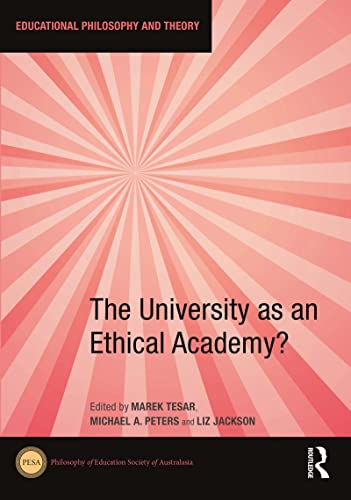
The university as an ethical academy? / edited by Marek Tesar, Michael A. Peters, Liz Jackson.
Language: English Publication details: London : Routledge, 2023.Edition: 2ndDescription: xi, 143pISBN:- 9781032350202
- 378.001 UNI-
| Cover image | Item type | Current library | Home library | Collection | Shelving location | Call number | Materials specified | Vol info | URL | Copy number | Status | Notes | Date due | Barcode | Item holds | Item hold queue priority | Course reserves | |
|---|---|---|---|---|---|---|---|---|---|---|---|---|---|---|---|---|---|---|
 Books
Books
|
NASSDOC Library | 378.001 UNI- (Browse shelf(Opens below)) | Available | 52745 |
Browsing NASSDOC Library shelves Close shelf browser (Hides shelf browser)


Includes bibliographical references and index.
This book examines the importance, possibilities, and complexities of the university as an ethical academy. Universities may be seen as an evolving network of ethical systems that govern teaching, research, service, and administration. However, the university system is changing: adding new rules, new ways of working, and new ideas to its repertoire of operations. The theories that we have traditionally employed may be now put up for questioning and examination. Universities now comprise a spectacularly large body of regulations and policies, both internal and external, that cover issues from cheating, human subject research, academic integrity, research on animals, environmental ethics, and the ethics of sexual harassment. These interconnected ecological systems of ethics have not emerged in one rational process but rather reflect the ongoing historical and dynamic development of law and ethics in relation to the creation of new values. This has played out in a particular political and ideological environment, which has produced the university as a set of practices and beliefs and a particular set of rationalities.
English.
There are no comments on this title.