
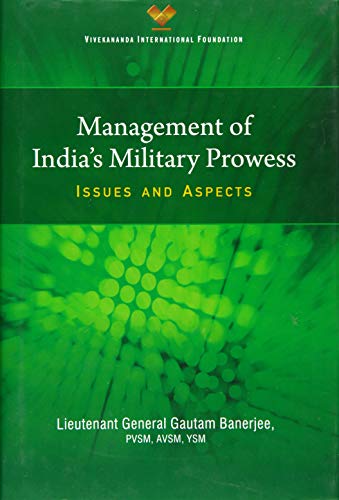
Management of India's military prowess : issues and aspects / By Gautam Banerjee
Publication details: New Delhi : Pentagon press, 2020Description: xi, 253 p. ; 23cmISBN:- 9789390095056
- 355.02 BAN-M
| Cover image | Item type | Current library | Home library | Collection | Shelving location | Call number | Materials specified | Vol info | URL | Copy number | Status | Notes | Date due | Barcode | Item holds | Item hold queue priority | Course reserves | |
|---|---|---|---|---|---|---|---|---|---|---|---|---|---|---|---|---|---|---|
 Books
Books
|
NASSDOC Library | 355.02 GAU-M (Browse shelf(Opens below)) | Available | 53925 |
Browsing NASSDOC Library shelves Close shelf browser (Hides shelf browser)

|

|

|

|

|

|

|
||
| 355.00954912 MOR-A The Army in India and The Development of Frontier Warfare, 1849-1947 / | 355.02 CRO- Cross-Domain Deterrence | 355.02 GAT-W War and strategy in the modern world : | 355.02 GAU-M Management of India's military prowess : | 355.02 IND- Indian Armed Forces in 2047 : | 355.02 JOR-U Understanding Modern Warfare | 355.02 MER-; How democracies lose small wars : state, society, and the failures of France in Algeria, Israel in Lebanon and the United States in Vietnam |
Copyright: Vivekananda International Foundation, New Delhi.
Includes index.
Foreword -- Author's note -- Introduction -- Part 1. Military institution in national perspective. 1. Politics, war and politics of war -- 2. Nurturing military institution : for the good of the nation -- 3. The state's burden of military security -- 4. Understanding civil-military relations -- 5. Preserving military institution : from within -- 6. One wonders : it happens only in India!! -- 7. Pretending 'soldiers' -- 8. The bureaucracy eternal... -- 9. Awakening to national defence : hope at last? -- Part 2. Military organisational reforms. 10. A call for transformation of Indian military -- 11. A native Indian military doctrine -- 12. Towards a joint approach to 'jointness' in war-fighting -- 13. Building up a case for a high military professional -- 14. Chief of defence staff : a debilitating dilemma -- 15. A transformational doctrine for India's military forces -- 16. Pakistan's nuclear war-dance -- 17. Empowerment of a power house : the Infantry Battalion -- Part 3. Military training, leadership and value system -- 18. Training for the transformational 'call' -- 19. A culture of leadership -- 20. Military management : need for farsighted policy making -- 21. The Indian military value system -- concluding the context -- Index.
Conceptualizing the foundations of national defense and organizing a conformingly robust military structure is a humungous task of extremely complexities. Even nations who possess pristine strategic vision and deep rooted military culture find it practically impossible to home on to the right equation between their political goals, military power and optimal resource allocation. The reason lies in the fact that no matter what mock drills one puts up, outcome of military campaigns often remain uncertain and unpredictable, and independent of the forces fielded to secure victory. There can be no right formulae, no right examples and no practice round to hone one`s concepts and practices before the final, bloody and destructive showdown. Irreversibility of war further makes it a nightmare for military planners to guarantee success. At the best they can apply their professional insight to anticipate adverse situations, notionally replicate these and then harness tactical acumen to find possibly the most effective courses of actions to deal with the circumstances. It is here that the salience of various issues discussed in this book come into contention. The book does not offer formulae for the achievement of military success. Rather it offers an insight into the ingredients and processes that enable military planners to conceive the best possible force composition to win wars.
There are no comments on this title.