
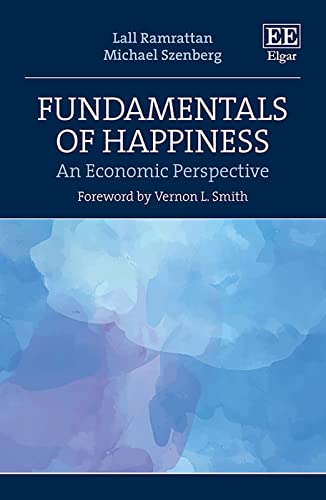
Fundamentals of happiness : an economic perspective / Lall Ramrattan, Michael Szenberg.
Publication details: UK: Edward Elgar, 2021.Description: xi, 211 pages : illISBN:- 9781839107726
- 330.01 RAM-F
| Cover image | Item type | Current library | Home library | Collection | Shelving location | Call number | Materials specified | Vol info | URL | Copy number | Status | Notes | Date due | Barcode | Item holds | Item hold queue priority | Course reserves | |
|---|---|---|---|---|---|---|---|---|---|---|---|---|---|---|---|---|---|---|
 Books
Books
|
NASSDOC Library | 330.01 RAM-F (Browse shelf(Opens below)) | Available | 54168 |
Browsing NASSDOC Library shelves Close shelf browser (Hides shelf browser)

|

|

|

|

|

|

|
||
| 330.01 GUP-E Economic philosophy of Mahatma Gandhi | 330.01 MIL-C Critical history of economics | 330.01 OXF- Oxford handbook of philosophy of economics | 330.01 RAM-F Fundamentals of happiness : | 330.01 SHA-G Gandhian Holistic Economics | 330.0112 HAN- Handbook of economic forecasting | 330.0113 ECO- Economics through graphs / |
Includes bibliographical references and index.
Examining the fundamental thinking underpinning the foundation for economic studies of happiness, this book explores the theories of key economists and philosophers from the Greek philosophers to more modern schools of thought. Lall Ramrattan and Michael Szenberg explore the general measures of happiness, utility as a method, metrical measures of happiness, happiness in literature, and the scope of happiness in this concise book. Fundamentals of Happiness builds on major moral and philosophical theories from the ancient, medieval, and modern schools that form the foundation of utility analysis. The authors classify the economics of happiness based on psychological, individual, social, and institutional views of happiness, revealing how historical schools of thought implicitly or explicitly deal with this. The book also focuses on the relationship between happiness and society and welfare, analysing the measurement of subjective well-being. This will be an invigorating read for economics students, in particular those studying the history of economic thought, looking to understand the basic principles underlying the economics of happiness. --
There are no comments on this title.