
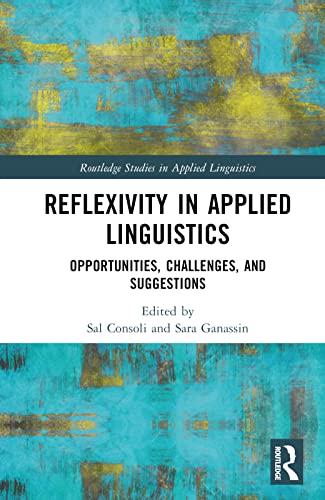
Reflexivity in applied linguistics: opportunities, challenges, and suggestions/ edited by Sal Consoli and Sara Ganassin.
Series: Routledge Studies in Applied LinguisticsPublication details: New York Routledge 2023Description: x, 215pISBN:- 9780367711177
- 418.0072 REF-
| Cover image | Item type | Current library | Home library | Collection | Shelving location | Call number | Materials specified | Vol info | URL | Copy number | Status | Notes | Date due | Barcode | Item holds | Item hold queue priority | Course reserves | |
|---|---|---|---|---|---|---|---|---|---|---|---|---|---|---|---|---|---|---|
 Books
Books
|
NASSDOC Library | 418.0072 REF- (Browse shelf(Opens below)) | Available | 54304 |
Browsing NASSDOC Library shelves Close shelf browser (Hides shelf browser)

|
|

|

|

|

|

|
||
| 413.0954 KUM-I; V 1 भारतीय कोश | 413.0954 KUM-I; V 2 भारतीय कोश | 415 COO-C Chomsky's universal grammar : | 418.0072 REF- Reflexivity in applied linguistics: | 418.02 FAU-T Translation and Interpreting: | 418.02 ROU- The Routledge handbook of translation and education/ | 418.02 SIN-A अनुवाद की व्यापक संकल्पना/ |
Includes bibliographical references and index.
This edited collection provides research-informed guidance on how reflexivity may be practised in applied linguistics research. Specifically, we promote reflexivity as an essential hallmark of quality research and argue that doing reflexivity confers greater transparency, methodological rigour, depth, and trustworthiness to our scholarly inquiries. The collection features perspectives from different sub-fields of applied linguistics, including intercultural communication, language education, and multilingualism, and draws on data from a range of settings, including language cafes, classrooms, workplaces, and migration and displacement contexts. Each chapter follows a unified structure i.e., theoretical background; context of the empirical study used as a backdrop for the chapter; an analysis of how reflexivity played out throughout the study and conclusions which include takeaway points for other researchers. This approach allows readers to gain a sound understanding of the challenges and affordances of doing reflexivity in concrete examples of applied linguistics research whilst also gaining guidance on how to nurture and report on researcher reflexivity as this unfolds throughout the lifetime of a project. This book will appeal to students and scholars in applied linguistics, particularly those with an interest in research methods in the areas of language education, multilingualism, and intercultural communication
There are no comments on this title.