
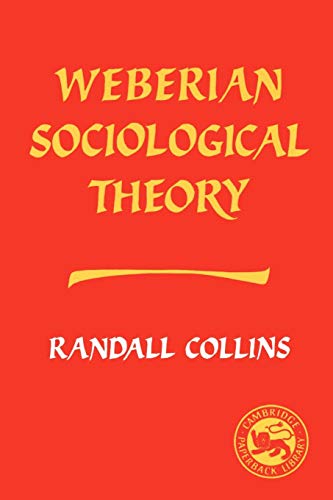
Weberian sociological theory / Randall Collins.
Language: eng- Publication details: New York: Cambridge University Press, 1986.Description: xi, 356 pISBN:- 9780521314268
- Weber, Max, 1864-1920 -- Criticism and interpretation -- Sociological theory
- Sociology -- Theoretical frameworks -- Weberian perspective
- Social structure -- Analysis -- Weber's contributions
- Rationalism -- Sociological aspects -- Weberian theory
- Bureaucracy -- Studies -- Sociological significance in Weber’s work
- Social action -- Theory -- Weberian analysis
- 301.01 COL-W
| Cover image | Item type | Current library | Home library | Collection | Shelving location | Call number | Materials specified | Vol info | URL | Copy number | Status | Notes | Date due | Barcode | Item holds | Item hold queue priority | Course reserves | |
|---|---|---|---|---|---|---|---|---|---|---|---|---|---|---|---|---|---|---|
 Books
Books
|
NASSDOC Library | 301.01 COL-W (Browse shelf(Opens below)) | Available | 54549 |
Browsing NASSDOC Library shelves Close shelf browser (Hides shelf browser)
| No cover image available | No cover image available |

|

|

|

|
No cover image available | ||
| 301.01 CHA-; Sociology of freedom | 301.01 CIC-; Method and measurement in sociology | 301.01 CLA; Classical sociological theory | 301.01 COL-W Weberian sociological theory / | 301.01 COM; Comparative social research: methodological problems and strategies | 301.01 COR; Core sociological dichotomies | 301.01 COS-M Masters of sociological thought: ideas in historical and social context |
Includes index.
Bibliography: p. 323-336.
Randall Collins convincingly argues that much of Max Weber's work has been misunderstood, and that many of his most striking and sophisticated theories have been overlooked. By analysing hitherto little known aspects of Weber's writings, Professor Collins is able both to offer a new interpretation of Weberian sociology and to show how the more fruitful lines of the Weberian approach can be projected to an analysis of current world issues. Professor Collins begins with Weber's theory of the rise of capitalism, examining it in the light of Weber's later writings on the subject and extending the Weberian line of reasoning to suggest a 'Weberian revolution' in both medieval Europe and China. He also offers a new interpretation of Weber's theory of politics, showing it to be a 'world-system' model; and he expands this into a theory of geopolitics, using as a particular illustration the prediction of the future decline of Russian world power. Another 'buried treasure' in the corpus is Weber's conflict theory of the family as sex and property, which Professor Collins applies to the historical question of the conditions that led to the initial rise in the status of women. The broad view of Weber's works shows that Weberian sociology remains intellectually alive and that many of his theories still represent the frontier of our knowledge about large-scale social processes.
English.
There are no comments on this title.