
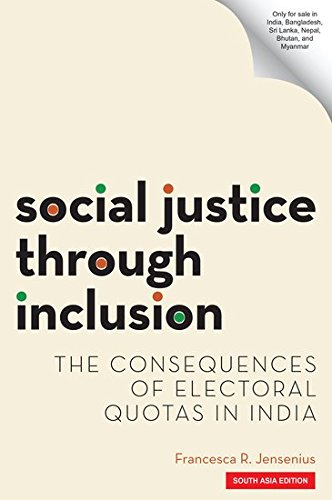
Social justice through inclusion : the consequences of electoral quotas in India
Publication details: New Delhi Oxford University Press 2017Description: xvii, 228pISBN:- 9780190884994
- 323.3294 JEN-S
| Cover image | Item type | Current library | Home library | Collection | Shelving location | Call number | Materials specified | Vol info | URL | Copy number | Status | Notes | Date due | Barcode | Item holds | Item hold queue priority | Course reserves | |
|---|---|---|---|---|---|---|---|---|---|---|---|---|---|---|---|---|---|---|
 Books
Books
|
NASSDOC Library | 323.3294 JEN-S (Browse shelf(Opens below)) | Available | 49784 |
Browsing NASSDOC Library shelves Close shelf browser (Hides shelf browser)

|

|

|

|

|

|

|
||
| 323.30954 OES-D Development and human rights | 323.32 MAN-; Human rights as practice: Dalit women securing livelihood entitlements in South Asia | 323.3293095482 GOR-P Panthers in Parliament | 323.3294 JEN-S Social justice through inclusion | 323.34 BUC-F From oppression to assertion: women and panchayats in India | 323.34 GON-W Women and human rights | 323.34 HUM; Human rights and gender politics: Asia-Pacific perspectives |
Includes Bibliography and Index
Across the world, governments design and implement policies with the explicit goal of promoting social justice. But can such institutions change entrenched social norms? And what effects should we expect from differently designed policies? Francesca R. Jensenius' Social Justice through Inclusion is an empirically rich study of one of the most extensive electoral quota systems in the world: the reserved seats for the Scheduled Castes (SCs, the former "untouchables") in India's legislative assemblies. Combining evidence from quantitative datasets from the period 1969-2012, archival work, and in-depth interviews with politicians, civil servants, and voters across India, the book explores the long-term effects of electoral quotas for the political elite and the general population. It shows that the quota system has played an important role in reducing caste-based discrimination, particularly at the elite level.
English
There are no comments on this title.