
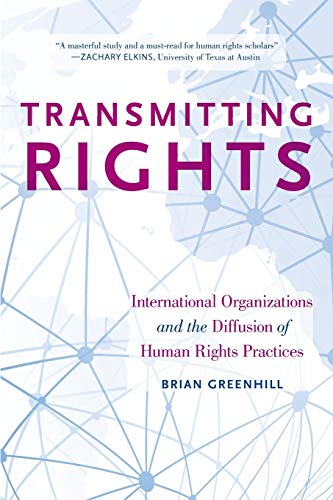
Transmitting rights : international organizations and the diffusion of human rights practices / Brian Greenhill.
Publication details: New York: Oxford University Press, 2015Description: x,194 pagesISBN:- 9780190271640
- 323 GRE-T
| Cover image | Item type | Current library | Home library | Collection | Shelving location | Call number | Materials specified | Vol info | URL | Copy number | Status | Notes | Date due | Barcode | Item holds | Item hold queue priority | Course reserves | |
|---|---|---|---|---|---|---|---|---|---|---|---|---|---|---|---|---|---|---|
 Books
Books
|
NASSDOC Library | 323 GRE-T (Browse shelf(Opens below)) | Available | 52096 |
Includes bibliographical references (pages 183-190) and index.
When considering the structures that drive the global diffusion of human rights norms, Brian Greenhill argues that we need to look beyond institutions that are explicitly committed to human rights and instead focus on the dense web of international government organizations (IGOs)-some big, some small; some focused on human rights; some not-that has arisen in the last two generations. While most of these organizations have no direct connection to human rights issues, their participation in broader IGO networks has important implications for the human rights practices of their member states. Featuring a rigorous empirical analysis, Transmitting Rights shows that countries tend to adopt similar human rights practices to those of their IGO partners, whether for better or worse. Greenhill argues that IGOs constitute a tightly-woven fabric of ties between states and that this network provides an important channel through which states can influence the behavior of others. Indeed, his analysis suggests that a policy of isolating "rogue" states is probably self-defeating given that this will reduce their exposure to some of the more positive IGO-based influences on their human rights. Greenhill's analysis of the role of IGOs in rights diffusion will not only increase our understanding of the international politics of human rights; it will also reshape how we think about the role of international institutions in world politics.
There are no comments on this title.