
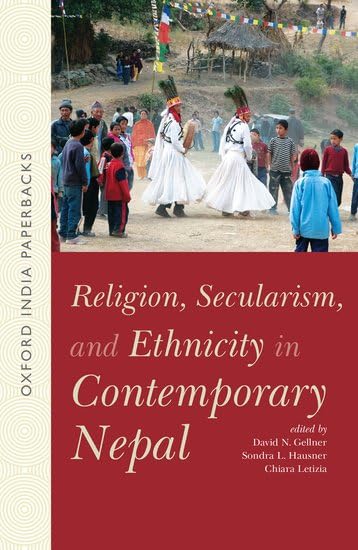
Religion, secularism and ethnicity in contemporary Nepal
Publication details: Oxford University Press 2018 New DelhiDescription: xiii, 491pISBN:- 9780199487813
- 211.6095496 REL-
| Cover image | Item type | Current library | Home library | Collection | Shelving location | Call number | Materials specified | Vol info | URL | Copy number | Status | Notes | Date due | Barcode | Item holds | Item hold queue priority | Course reserves | |
|---|---|---|---|---|---|---|---|---|---|---|---|---|---|---|---|---|---|---|
 Books
Books
|
NASSDOC Library | 211.6095496 REL- (Browse shelf(Opens below)) | Available | 50503 |
Include index
The socio-political landscape of Nepal has seen dramatic and far-reaching changes in the past thirty years. The former Hindu kingdom has declared its commitment to secularism without agreement on what secularism means or should mean in the Nepalese context. What happens to religion under conditions of such rapid social and political change? How is the state dealing with Nepal’s multicultural and multi-religious society? How are Nepalese understanding, resisting and adapting ideas of secularism? To answer these questions, this volume brings together eleven case studies by an international team of anthropologists and ethno-Indologists of Nepal on a range of diverse topics, such as secularism, new religious movements, shamanism, animal sacrifice, ethnic revival and the clashes and synergies between Maoism and Buddhism. Political philosopher Rajeev Bhargava provides a comparative analysis in the Afterword.
There are no comments on this title.