
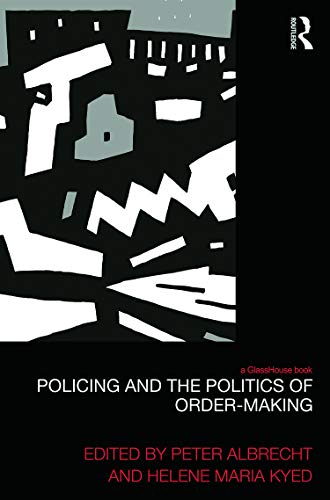
Policing and the politics of order-making / edited by Peter Albrecht and Helene Maria Kyed.
Language: English. Publication details: Abingdon, Oxon ; New York, NY : Routledge, 2015.Description: xvi, 202pISBN:- 9780415743303 (hardback)
- 363.23 POL-

| Cover image | Item type | Current library | Home library | Collection | Shelving location | Call number | Materials specified | Vol info | URL | Copy number | Status | Notes | Date due | Barcode | Item holds | Item hold queue priority | Course reserves | |
|---|---|---|---|---|---|---|---|---|---|---|---|---|---|---|---|---|---|---|
 Books
Books
|
NASSDOC Library | 363.23 POL- (Browse shelf(Opens below)) | Available | 53153 |
Includes bibliographical references and index.
"In the urban spaces that the book explores, a plurality of order-making practise, norms and actors co-exist in an often contested and transient environment. State police and various civilian policing groups are constituted in relation to each other through a mixture of competition, collaboration and interdependence. Collectively, they draw on a variety of both violent and non-violent repertoires of order-making and are animated by a mix of cultural, religious and state-based norms. This compels us to analytically approach policing practices and actors as embedded not only in police networks, but also in the broader social and political relations and networks of urban space. This is the key contribution of Policing and the Politics of Order-making: To explore the political underpinning of local order-making in contexts of plural policing"--
English.
There are no comments on this title.