
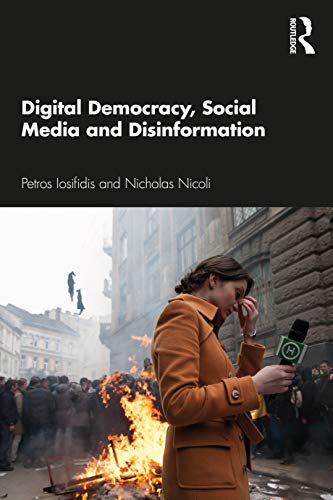
Digital democracy, social media and disinformation / Petros Iosifidis, Nicholas Nicoli
Language: eng- Publication details: London : Routledge, 2020.Description: 172pISBN:- 9780367332105
- 303.4833 LOS-D
| Cover image | Item type | Current library | Home library | Collection | Shelving location | Call number | Materials specified | Vol info | URL | Copy number | Status | Notes | Date due | Barcode | Item holds | Item hold queue priority | Course reserves | |
|---|---|---|---|---|---|---|---|---|---|---|---|---|---|---|---|---|---|---|
 Books
Books
|
NASSDOC Library | 303.4833 LOS-D (Browse shelf(Opens below)) | Available | 53358 |
Includes bibliographical references and index.
Digital Democracy, Social Media and Disinformation discusses some of the political, regulatory and technological issues which arise from the increased power of internet intermediaries (such as Facebook, Twitter and YouTube) and the impact of the spread of digital disinformation, especially in the midst of a health pandemic.
The volume provides a detailed account of the main areas surrounding digital democracy, disinformation and fake news, freedom of expression and post-truth politics. It addresses the major theoretical and regulatory concepts of digital democracy and the ‘network society’ before offering potential socio-political and technological solutions to the fight against disinformation and fake news. These solutions include self-regulation, rebuttals and myth-busting, news literacy, policy recommendations, awareness and communication strategies and the potential of recent technologies such as the blockchain and public interest algorithms to counter disinformation.
After addressing what has currently been done to combat disinformation and fake news, the volume argues that digital disinformation needs to be identified as a multifaceted problem, one that requires multiple approaches to resolve. Governments, regulators, think tanks, the academy and technology providers need to take more steps to better shape the next internet with as little digital disinformation as possible by means of a regional analysis. In this context, two cases concerning Russia and Ukraine are presented regarding disinformation and the ways it was handled.
Written in a clear and direct style, this volume will appeal to students and researchers within the social sciences, computer science, law and business studies, as well as policy makers engaged in combating what constitutes one of the most pressing issues of the digital age.
English.
There are no comments on this title.